A miter saw is an indispensable tool for any serious woodworker or DIY enthusiast, capable of delivering precise crosscuts and angled cuts for everything from crown molding to deck building. However, even the most powerful miter saw is only as good as the blade spinning within it. Choosing the best blade for miter saw applications can dramatically impact the quality of your cuts, the efficiency of your work, and the lifespan of your tool. A dull or inappropriate blade can lead to tear-out, burning, and frustrating inaccuracies, turning a simple task into a challenging chore. That’s why investing in the right blade is crucial for achieving professional-looking results and ensuring a smooth, safe cutting experience.
Quick Product Comparison
Our Top 5 Best Blade For Miter Saw Reviews – Expert Tested & Recommended
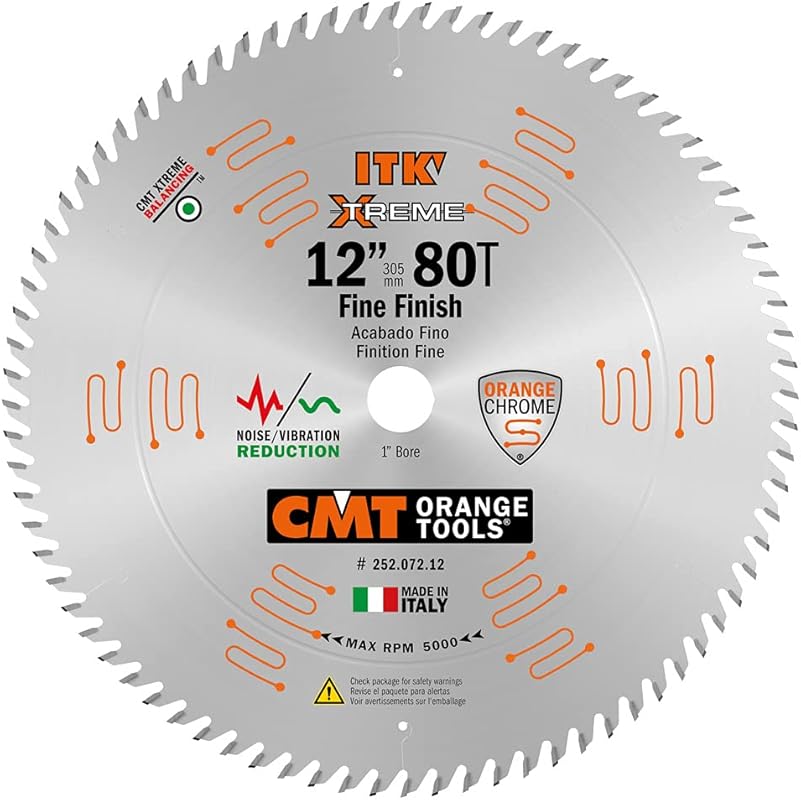
1. CMT Fine Cut-Off Saw Blade, 12-Inch, 80 Teeth, Ideal for Precision Miter Saw Cuts.
The CMT Fine Cut-Off Saw Blade is a top-tier choice for anyone seeking utmost precision and a flawless finish from their miter saw. With 80 teeth, it’s engineered to deliver extra-clean crosscuts on both soft and hardwood, as well as plywood. This blade isn’t just for miter saws; its versatile design also allows for effective use on radial arm saws and table saws, making it a valuable addition to any workshop.
Key Features That Stand Out
- ✓ 80-tooth design for exceptionally clean, precise cuts.
- ✓ Versatile for crosscuts and occasional rips on various wood types and plywood.
- ✓ Suitable for use on radial arm saws, miter saws, and table saws.
- ✓ Durable carbide construction ensures extended blade life and consistent performance.
- ✓ Optimized 0.110 kerf thickness and specific tooth grind for efficient material removal and smooth operation.
Why We Recommend It
This CMT blade consistently delivers outstanding results, especially when fine finish work is paramount. Its carefully engineered tooth geometry and robust construction mean you get minimal tear-out and a smooth cut every single time. It’s truly one of the best blades for miter saw precision tasks, making delicate trim work and intricate joinery a breeze.
Best For
Woodworkers, cabinetmakers, and DIYers who prioritize exceptionally clean, splinter-free crosscuts on expensive hardwoods, plywood, and other finish materials, where precision and aesthetics are critical.
Pros and Cons
Pros:
- Produces incredibly clean, precise cuts with minimal tear-out.
- High tooth count (80T) ideal for fine finish work.
- Durable construction ensures a long lifespan.
- Versatile for use on multiple saw types (radial, miter, table).
Cons:
- Higher tooth count might lead to slower cuts compared to lower-tooth blades.
- May not be ideal for heavy-duty ripping of very thick stock.
Customer Reviews
Customer Review: Great replacement for the original blade on my Dewalt DWS779 miter saw. Very clean cuts with minimal tear out. Great blade for the price point. We’ll see how it holds up over time.
Customer Review: This blade cuts amazingly right out of the package.I hope it proves to be a reliable blade.
2. WEN BL1080 10-Inch 80-Tooth Carbide-Tipped Ultra-Fine Finish Professional Woodworking Saw Blade f…
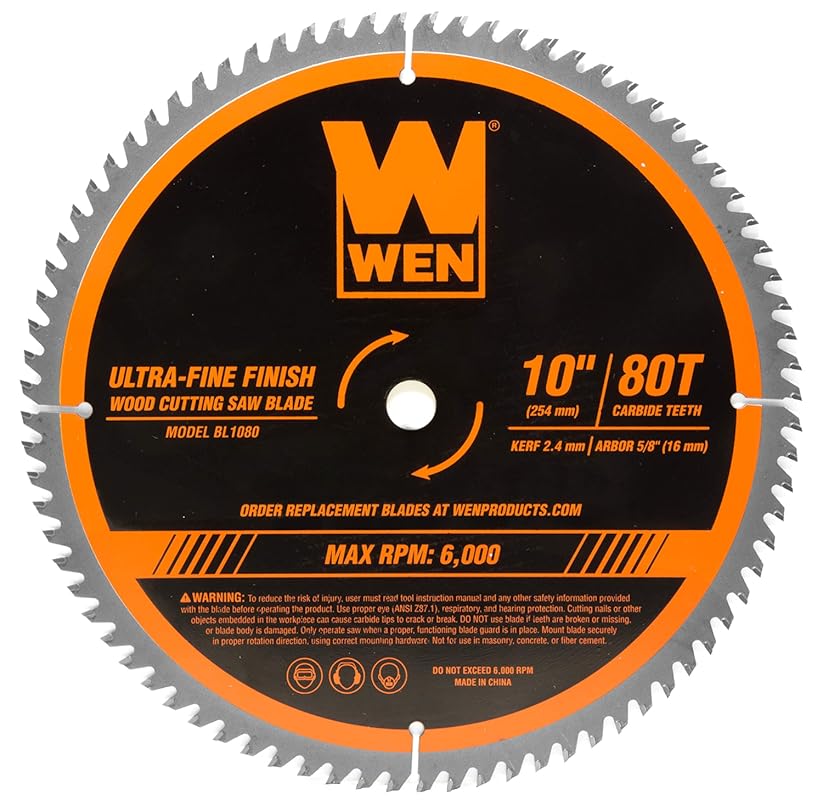
The WEN BL1080 stands out as an excellent choice for those needing a high-quality 10-inch blade for their miter saw, delivering an ultra-fine finish without a hefty price tag. Its 80 carbide-tipped teeth and ultra-thin kerf are designed for smooth, efficient cuts through both hard and softwoods. This professional-grade blade ensures durability and reliability for your daily woodworking tasks.
Key Features That Stand Out
- ✓ 80 carbide-tipped teeth for an ultra-fine finish on all wood types.
- ✓ 10-inch diameter (254 mm) with a 5/8-inch arbor (15.88 mm) to fit most standard miter saws.
- ✓ Rated for up to 6000 RPM, accommodating powerful miter saws.
- ✓ Ultra-thin 1/10-inch (2.4 mm) kerf provides clean, efficient cuts and reduces material waste.
- ✓ Designed for slicing through both hard and softwoods, ensuring versatility in your projects.
Why We Recommend It
The WEN BL1080 offers an impressive combination of precision, durability, and affordability, making it a fantastic all-around miter saw blade. Its ultra-thin kerf means less material waste and less strain on your saw, while the high tooth count ensures consistently clean edges. It’s a smart upgrade for noticeable improvements in cut quality.
Best For
DIYers and professional woodworkers seeking a reliable, high-performance 10-inch fine-finish blade for general woodworking, cabinetry, and trim work on various hard and softwoods, offering great value.
Pros and Cons
Pros:
- Delivers ultra-fine, clean cuts due to high tooth count.
- Excellent value for its performance.
- Thin kerf reduces material waste and power consumption.
- Durable carbide tips ensure longevity.
Cons:
- 10-inch size might not be suitable for 12-inch miter saws.
- Fine-finish blades can wear faster if used for aggressive ripping.
Customer Reviews
Customer Review: This is a decent 80 tooth carbide blade at a very attractive price. I’m not making fine furniture for a living, and am not overly concerned about minimizing cutting time, tooth marks or sanding time, so very expensive blades are largely wasted on me. And having said that, this blade delivers a very clean cut.
Customer Review: Works great, still going, sharp, strong great quality for the price. Cuts accurately for 1/8 the cost od DW junk.
3. Freud Thin Kerf Sliding Compound Miter Saw Blade, 12-Inch, 72 Teeth, for Superior Crosscuts.
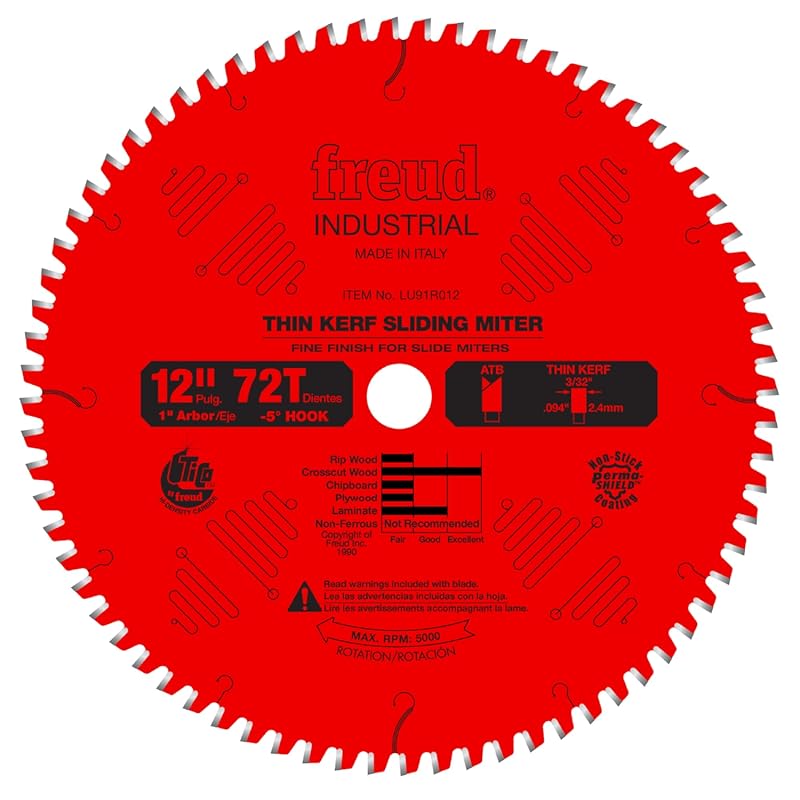
Freud is a name synonymous with quality in woodworking, and their Thin Kerf Sliding Compound Miter Saw Blade lives up to that reputation. This 12-inch, 72-tooth blade is specifically engineered for superior crosscuts, making it an exceptional choice for precision work. Its unique negative hook angle and premium TiCo Carbide blend ensure both safety and incredible cutting performance, even with less powerful saws thanks to its thin kerf design.
Key Features That Stand Out
- ✓ 72 teeth with a thin kerf design for efficient and precise cuts.
- ✓ 5° negative hook angle helps prevent aggressive cutting and improves safety by pushing the workpiece down.
- ✓ Premium TiCo Carbide blend maximizes cutting performance, edge retention, and durability.
- ✓ Designed specifically for superior crosscuts, especially with sliding compound miter saws.
- ✓ Thin kerf requires less horsepower, making it suitable for a wider range of saws.
Why We Recommend It
For superior crosscutting with a sliding compound miter saw, this Freud blade is hard to beat. The negative hook angle offers enhanced control and safety, crucial for delicate trim work. The thin kerf design reduces strain on your saw while delivering excellent results, embodying why it’s a top contender for the best blade for miter saw precision work.
Best For
Professionals and serious hobbyists using sliding compound miter saws who need exceptionally clean and precise crosscuts on a variety of wood materials, especially for cabinetry, trim, and molding applications.
Pros and Cons
Pros:
- Exceptional clean cuts, particularly for crosscutting.
- Thin kerf design reduces load on the saw motor.
- Negative hook angle improves safety and cut quality on miter saws.
- Durable TiCo carbide blend extends blade life.
Cons:
- May not be the fastest for extremely aggressive cuts.
- Specifically optimized for crosscuts, less ideal for rip cuts.
Customer Reviews
Customer Review: I purchased this Freud Industrial class blade from Amazon for use in my Ridgid sliding compound miter saw some time back, and it has worked in a championship way. It cuts clean, although it is no speed demon, and one thing it can do well is cut shallow dado grooves with no tear out. I did this when I was making a simple picture frame with excellent results.
Customer Review: This is one of the best blades I have put on yet. Clean cuts and little to no effort getting through the wood. I haven’t seen any burning yet from the crosscuts I’ve been making on hard and soft wood. Highly recommend. Will be staying with this company for the foreseeable future.
4. DEWALT Miter Saw Blades, 12-Inch, 40 and 60 Tooth, for Fine Finish.
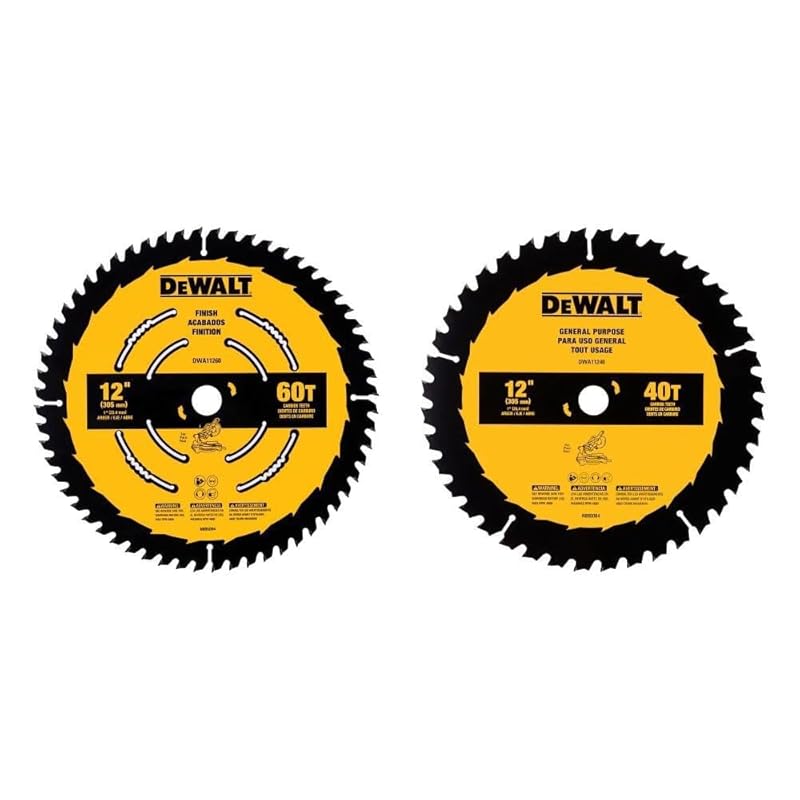
This DEWALT Miter Saw Blade pack offers incredible versatility, providing both a 40-tooth and a 60-tooth 12-inch blade, perfect for tackling a range of projects. Designed for increased accuracy and fine finish work, these blades boast a patented body slot design for low vibration, ensuring cleaner cuts and a more comfortable user experience. DEWALT’s reputation for durability means these blades are built to last, providing up to 3X life.
Key Features That Stand Out
- ✓ Dual pack includes 40-tooth and 60-tooth 12-inch miter saw blades for versatile application.
- ✓ Designed for increased accuracy and fine finish, suitable for various woodworking tasks.
- ✓ Patented body slot design minimizes vibration, leading to smoother cuts and reduced fatigue.
- ✓ Optimized tooth geometry contributes to enhanced precision and cut quality.
- ✓ Engineered for extended blade life, offering up to 3X the lifespan of standard blades.
Why We Recommend It
For those who need to switch between general-purpose cutting and fine finish work, this DEWALT two-pack is an exceptional value. The combination of tooth counts covers most woodworking needs, while DEWALT’s commitment to durability and accuracy ensures these blades perform consistently. It’s an excellent choice for a well-rounded miter saw blade arsenal.
Best For
Homeowners, contractors, and DIY enthusiasts who require versatile miter saw blades to handle a variety of materials and projects, from framing and rough cuts to precise trim and finish work, all while valuing durability and accuracy.
Pros and Cons
Pros:
- Two blades (40T and 60T) offer excellent versatility for different cuts.
- Designed for increased accuracy and fine finish work.
- Low vibration due to patented body slot design.
- Promises extended blade life.
Cons:
- The 40T blade might still cause some tear-out on very delicate materials.
- Not as specialized as a dedicated ultra-fine finish blade for specific tasks.
Customer Reviews
Customer Review: I trust and appreciate the Dewalt quality and performance. I have only used the 60T blade but it cuts through 2×8 pressure treated lumber with ease. Arrived quickly and the price seemed better than what I would pay at HD. These appear durable and I will purchase again when needed.
Customer Review: I purchased these because I got a pretty good sale price on the pair. It is probably unfair to give them a 5 star rating, because I have not had a project to use them on yet. I’ve had DEWALT saw blades in the past though and they’ve held up very well. I will change my rating once I’ve had a chance to use them on a project.
5. DEWALT Miter Saw Blade, 12-Inch, 100 Tooth, for an Excellent Fine Finish.
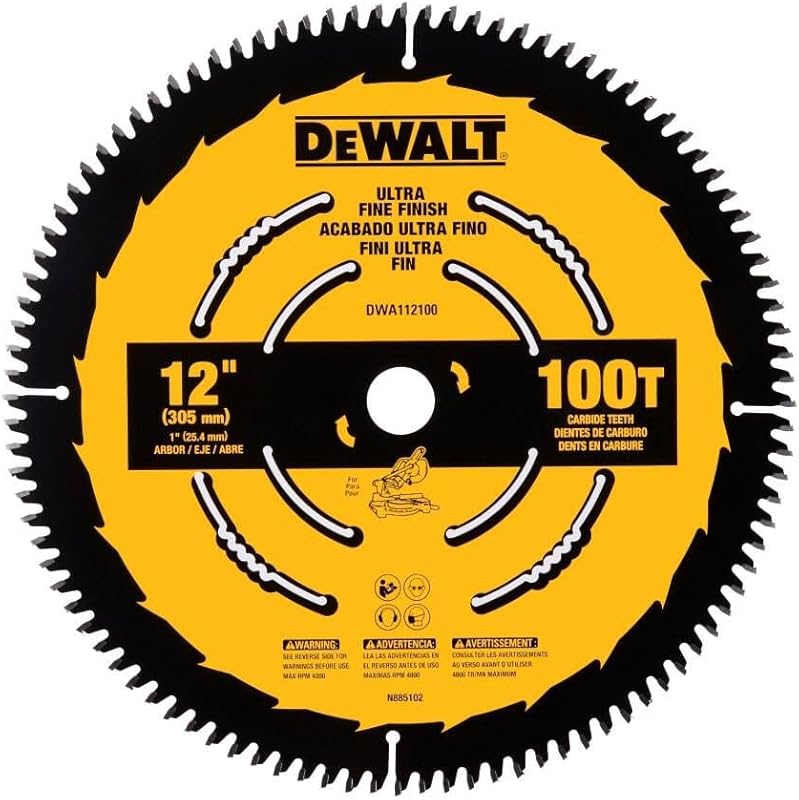
When an excellent fine finish is your top priority, the DEWALT 12-Inch, 100-Tooth Miter Saw Blade delivers. This blade is meticulously designed for superior finish quality, minimizing tear-out and leaving behind incredibly smooth edges. Featuring DEWALT’s patented body slot design for low vibration and optimized tooth geometry, it ensures highly accurate cuts and promises up to 3X longer life for consistent, reliable performance.
Key Features That Stand Out
- ✓ 100-tooth count delivers an excellent fine finish with minimal tear-out.
- ✓ Patented body slot design significantly reduces vibration and noise during operation.
- ✓ Optimized tooth geometry enhances accuracy for precise and clean cuts.
- ✓ Engineered for up to 3X longer life, ensuring extended durability and value.
- ✓ Ideal for achieving superior finish quality on a wide range of materials.
Why We Recommend It
For those demanding the absolute cleanest cuts for high-visibility projects, this 100-tooth DEWALT blade is a game-changer. It transforms a standard miter saw into a precision finishing tool, making it perfect for applications where every detail counts. Its low vibration design also contributes to a more comfortable and controlled cutting experience.
Best For
Craftsmen, finish carpenters, and dedicated DIYers who require the highest level of finish quality for trim, moldings, cabinetry, and other intricate woodworking projects where a pristine cut is non-negotiable.
Pros and Cons
Pros:
- Produces an exceptionally smooth and fine finish.
- High tooth count minimizes tear-out on delicate materials.
- Low vibration design for comfortable and accurate cutting.
- Long-lasting durability expected from DEWALT.
Cons:
- Higher cost than lower-tooth count blades.
- Slower cutting speed compared to general-purpose blades.
Customer Reviews
Customer Review: Great blade giving me sharp clean cuts! Lasts quite a while been using almost daily for months and still giving great cuts. Will absolutely buy again.
Customer Review: Excellent blade. Great for finish work and cutting LVP. Does exactly what it is designed to do.
Complete Buying Guide for Best Blade For Miter Saw
Essential Factors We Consider
Choosing the best blade for miter saw use involves understanding several key factors that influence performance and cut quality. First and foremost is the tooth count (TPI). A higher tooth count (e.g., 60-100T) results in finer, smoother cuts with less tear-out, ideal for finish work like trim and molding. Conversely, a lower tooth count (e.g., 24-40T) cuts faster but might leave a rougher finish, making it better for framing or rough lumber. The kerf thickness, which is the width of the cut the blade makes, also matters. Thin-kerf blades remove less material, reducing strain on your saw and material waste, but can sometimes deflect more easily. Standard kerf blades are sturdier but require more power. Consider the blade material; carbide-tipped teeth are standard for durability and sharpness. Finally, the hook angle of the teeth is important for miter saws. A negative hook angle (like -5°) is safer for miter saws as it pushes the workpiece down and into the fence, reducing climb-cut risk, while a positive hook angle is more aggressive and common on table saw ripping blades.
Budget Planning
When planning your budget for the best blade for miter saw, it’s easy to get caught between incredibly cheap options and very expensive professional-grade blades. While it might be tempting to save money on a blade, remember that a good quality blade significantly improves your project’s outcome and safety. Entry-level carbide-tipped blades offer decent performance for occasional DIY tasks. Mid-range blades provide a good balance of durability, cut quality, and price, often featuring enhanced carbide blends and anti-vibration designs. High-end blades, while a larger upfront investment, typically offer superior cut quality, extended lifespan, and can be resharpened multiple times, proving more cost-effective in the long run for frequent users or professionals. Think about how often you’ll use the blade and the importance of the finish quality for your typical projects when deciding where to invest.
Final Thoughts
Ultimately, the “best” miter saw blade isn’t a one-size-fits-all answer. It truly depends on your specific needs, the materials you commonly cut, and the desired finish quality. For general-purpose work, a versatile 60-tooth blade might be perfect. If you’re consistently doing fine finish carpentry, investing in a high-tooth-count blade (80-100T) will be worth every penny. Always ensure the blade size and arbor hole match your miter saw’s specifications. Don’t underestimate the impact a quality blade can have on both your projects and your overall woodworking experience. A little research now can save you a lot of frustration and wasted material later.
Frequently Asked Questions
Q: What tooth count is best for a miter saw blade?
A: It depends on your project. For fine, splinter-free crosscuts on finish materials like trim, molding, or plywood, a higher tooth count (60-100T) is ideal. For faster, general-purpose cuts or framing lumber, a lower tooth count (40-60T) is more suitable as it removes material more aggressively and efficiently.
Q: Can I use a miter saw blade on a table saw?
A: While some blades are rated for use on both tools, it’s generally best to use blades designed specifically for each. Miter saw blades often feature a negative hook angle for safer crosscutting, which might not be ideal for all table saw applications, especially ripping where a positive hook angle is often preferred. Always check the blade’s specifications and manufacturer recommendations to ensure safety and optimal performance.
Q: What is “thin kerf” and why does it matter for a miter saw blade?
A: Thin kerf refers to a saw blade with a thinner cutting width (typically around 0.090 to 0.100 inches). It matters because it removes less material during a cut, which reduces the load on your miter saw’s motor and requires less horsepower. This also results in less wasted material, which can be beneficial when working with expensive wood. However, thin kerf blades can be more prone to deflection if not supported correctly or if used for very aggressive cuts.
Q: How do I know when to replace my miter saw blade?
A: Look for several signs indicating your miter saw blade is dull or damaged. These include increased splintering or tear-out on your workpiece, burning of the wood, increased effort needed to push the saw through material, excessive noise or vibration during cuts, or visible damage to the carbide teeth (missing, chipped, or rounded). A dull blade not only produces poor results but can also be dangerous.
Q: Is a higher tooth count always better for a miter saw blade?
A: Not necessarily. While a higher tooth count (e.g., 80T-100T) provides a smoother, finer finish, it also cuts slower and is generally less effective for aggressive ripping or cutting very thick stock. A 40-60T blade offers a good balance of speed and finish for many common tasks with a miter saw, making it a versatile choice for general woodworking.
Choosing the best blade for miter saw use is a pivotal decision that directly impacts the quality and efficiency of your woodworking projects. From precision finish work to heavy-duty crosscutting, the right blade makes all the difference, enhancing safety, prolonging tool life, and delivering the clean, accurate results you desire. We’ve explored some of the top contenders in the market, each excelling in different areas to meet diverse needs and budgets. We hope this guide has provided clarity and confidence in making your next purchase. Remember, a high-quality blade is an investment that pays dividends in superior craftsmanship and a more enjoyable woodworking experience. So, take your time, consider your specific projects, and select the blade that will truly elevate your miter saw’s performance. Ready to upgrade your cuts? Check out our recommended blades today and transform your woodworking!

I’m Darrell Julian, the founder, lead writer, and hands-on welding enthusiast behind ArcWeldingPro.com. With more than 15 years of real-world welding experience, I created this platform to share what I’ve learned in the field, in the shop, and in the heat of the arc.